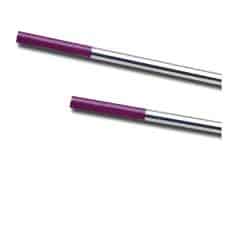
The E3 Purple Tungsten Electrode (0.040" x 7") represents a significant advancement in TIG welding consumable technology. Engineered with a proprietary blend of rare earth oxides—specifically 1.5% Lanthanum, 0.08% Zirconium, and 0.08% Yttrium—this electrode is designed to replace thoriated tungsten while eliminating the hazards associated with radioactivity. The unique chemical composition provides a lower work function than pure tungsten, facilitating easier electron emission. This results in reliable arc ignition and re-ignition, which is critical for automated welding cycles and precision manual applications involving thin materials.
Thermal conductivity is another area where E3 excels. The electrode runs cooler than its thoriated counterparts, reducing the rate of tip degradation and minimizing the formation of thermal dendrites at the grain boundaries. For the professional fabricator, this translates to a geometrically stable tip that maintains its grind angle for longer durations, ensuring consistent weld bead profiles and penetration depth. The 0.040-inch diameter is specifically suited for low-amperage applications, providing exceptional control on micro-welds and thin-gauge sheet metal where heat input management is paramount.
Versatility is a core attribute of the E3 formulation. Unlike specialized electrodes that are limited to specific current types, the E3 Purple tungsten performs exceptionally well on both Direct Current (DC) for stainless and mild steels, and Alternating Current (AC) for aluminum and magnesium alloys. This dual-capability reduces inventory complexity for job shops handling diverse materials. The electrode maintains a stable arc even at the low amperage ranges required for 0.040" diameter work, preventing arc wandering and ensuring high-quality defect-free welds.
| Additional Information |
|---|
| Diameter:0.040 in |
| Tungsten Type:E3 |
| Used To Weld:Steel or Stainless or Aluminum |
| Packaging Description:10 pcs in a pack (10-pcs-in-a-pack) |
| Color Code:Purple |
| Length:7 in |
| Current Type:AC, DC |
| Material Composition:Rare Earth Oxides, 1.5% Lanthanum, 0.08% Zirconium, 0.08% Yttrium |
| Amperage Range (DC):10 - 80 A |
| Amperage Range (AC):10 - 50 A |
| Used To Weld?:Steel or Stainless or Aluminum |