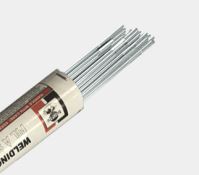
The EX404300000047-M00 is a premium quality ER4043 aluminum welding wire designed for the Gas Metal Arc Welding (GMAW) process. Featuring a diameter of 0.047 inches (approx. 1.2mm), commonly referred to as 3/64", this wire is a staple in industrial fabrication environments where aluminum joining is required. The 4043 alloy is formulated with approximately 5% silicon, which acts as a critical depression of the melting point, enhancing the fluidity of the weld pool. This characteristic makes it the preferred choice for welding heat-treatable base alloys, specifically the 6xxx series such as 6061 and 6063.
For procurement managers and shop foremen, this wire represents a reliable solution for minimizing downtime associated with feedability issues or weld defects. The silicon content not only aids in wetting but also significantly reduces the alloy's sensitivity to solidification cracking, ensuring structural integrity in the final assembly. It is widely used in automotive manufacturing, frame fabrication, and general repair of aluminum castings. While it typically produces a lower tensile strength than 5356 alloys, its ease of use and superior bead appearance make it the standard for general-purpose applications.
This product is manufactured to meet rigorous industry standards, ensuring consistent diameter control and surface cleanliness. Clean wire is essential for aluminum welding to prevent porosity and liner clogging. This spool is designed for use with standard MIG welding equipment capable of running aluminum, typically requiring a push-pull gun or a spool gun for optimal feeding of the softer aluminum material.
| Additional Information |
|---|
| Alloy Type:ER4043 |
| Diameter:0.047", 1.2mm (0.045"), 2.0mm (5/64") |
| Process:MIG (GMAW) |
| Material:Aluminum |
| AWS Classification:ER4043 |
| Shielding Gas Requirement:100% Argon, Argon/Helium Mixtures |
| Wire Diameter:0.047" (1.2mm) |
| Polarity:DCEP |
| Welding Position:All Positions |
| Applications:Automotive components, Bicycles, General fabrication, Aerospace hardware |
| Packaging Description:20 lb spool |
| Weld Process:MIG (GMAW) |
| AWS Spec:ER4043 |
| Packaging:20 lb Spool |
| Brand:Nexalloy |
| Position:All Position |