Canadian owned and operated
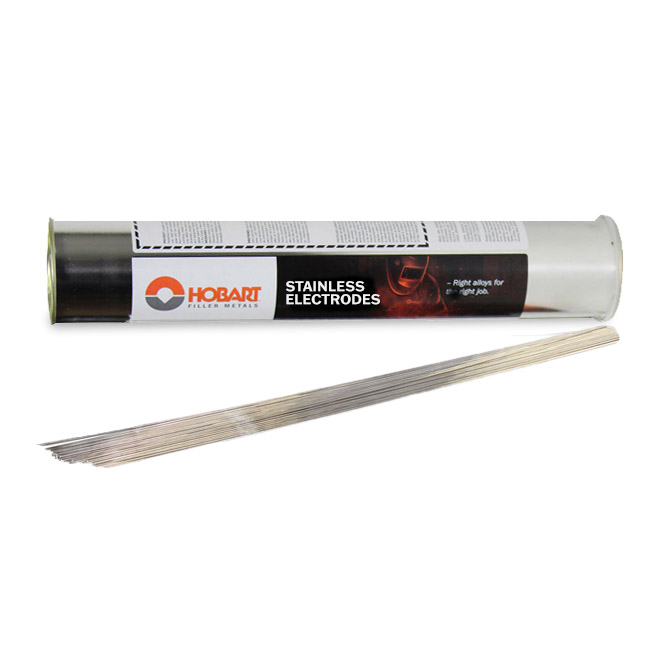
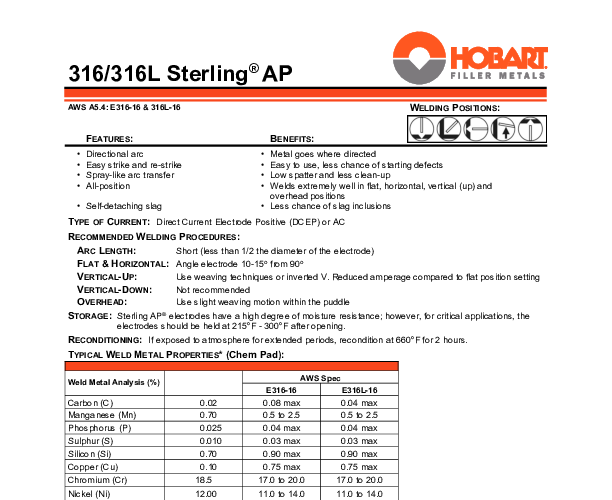
The Hobart Sterling AP 316/316L is a premium quality Shielded Metal Arc Welding (SMAW) electrode designed for joining molybdenum-bearing austenitic stainless steels. Engineered with a rutile-based coating, this electrode is formulated to meet AWS E316L-16 classifications, offering exceptional performance in all welding positions. The "L" designation indicates a low carbon content (maximum 0.04%), which is critical for preventing carbide precipitation during the welding process. This feature significantly reduces the risk of intergranular corrosion and sensitization, making it an optimal choice for service environments subject to corrosive media.
Metallurgically, the deposited weld metal exhibits high resistance to pitting and fissuring, ensuring structural integrity in demanding applications. The electrode operates effectively on both Direct Current Electrode Positive (DCEP) and Alternating Current (AC), providing a stable, soft arc with minimal spatter. The resulting weld bead is characterized by a flat to slightly convex profile with fine ripple formation, which is desirable for both cosmetic appearance and fatigue resistance. The slag system is designed to be self-peeling or easily removable, reducing the labor required for inter-pass cleaning and post-weld finishing.
This electrode is specifically recommended for welding Type 316, 316L, and 318 stainless steels. It is widely utilized in industries requiring strict adherence to sanitation and corrosion standards, such as chemical processing, textile manufacturing, and food production facilities. The controlled ferrite number in the weld deposit further aids in preventing hot cracking, a common issue in fully austenitic stainless steel welds.
| Additional Information |
|---|
| Packaging Description:18lb can |
| Diameter:3.2mm (3-2mm) |
| Grade:316 (316) |
| Weld Process:Stick (stick) |
| Polarity:AC or DC+ (ac-or-dc) |
| AWS Spec :E316L-16 (e316l-16) |
| Rod Type:Stick Electrode |
| Coating Type:Rutile |
| Welding Position:All Position |
| Material Composition:Stainless Steel |
| Packaging Type:Can |
| ----- new values below ---- |
| Rod Type:Stick Electrode |
| Coating Type:Rutile |
| Welding Position:All Position |
| Material Composition:Stainless Steel |
| Packaging Type:Can |
| Brand:Hobart |
| Diameter:3.2mm (3-2mm) |
| Grade:316 (316) |
| Weld Process:Stick (stick) |
| Polarity:AC or DC+ (ac-or-dc) |
| AWS Spec:E316L-16 (e316l-16) |