Canadian owned and operated

The Harris Aluminum Bronze TIG Welding Rod (Internal SKU: HAR3ALB250) is a premium-grade filler metal classified under AWS A5.7 as ERCuAl-A2. This iron-bearing copper-aluminum alloy is engineered for high-stress industrial applications requiring a combination of mechanical strength, ductility, and exceptional corrosion resistance. The addition of approximately 1% iron to the copper-aluminum matrix acts as a grain refiner, significantly enhancing the tensile strength to typical values of 79,000 PSI and increasing the yield strength compared to standard silicon bronzes. This metallurgical structure makes the alloy particularly effective in resisting wear, abrasion, and erosion-corrosion, which are common failure modes in fluid handling and marine propulsion systems.
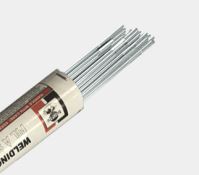
Designed for the Gas Tungsten Arc Welding (GTAW/TIG) process, these 3/32-inch diameter rods are supplied in 36-inch straight lengths, packaged in a durable 10 lb tube to ensure moisture protection and inventory stability. The rod is chemically balanced to provide sound, porosity-free welds when used with 100% Argon shielding gas on Direct Current Electrode Negative (DCEN). It is an intermediate hardness alloy, typically depositing weld metal with a hardness of 130-150 Brinell, making it machinable while still offering substantial resistance to metal-to-metal wear.
In industrial MRO (Maintenance, Repair, and Operations) settings, the Harris Aluminum Bronze rod is the filler of choice for repairing aluminum bronze castings, such as pump housings, valve bodies, and ship propellers. It is also extensively used for overlaying wear-resistant surfaces on steel and cast iron substrates, providing a bearing surface that resists galling. Furthermore, its ability to join dissimilar metals—specifically copper-base alloys to ferrous metals—adds to its versatility in complex fabrication projects. The alloy's resistance to salt water and various acids makes it a critical inventory item for shipyards, desalination plants, and chemical processing facilities.
Key Technical Specifications:
| Additional Information |
|---|
| Packaging Description:10 lb tube |
| Weld Process:TIG |
| Grade:Aluminum, Aluminum Bronze |
| Packaging:10lb tube |
| Brand:Harris |
| Diameter:2.5mm, 3/32" |
| Position:n/a |
| Polarity:DCEN, NA |
| AWS Classification:ERCuAl-A2 |
| Rod Type:TIG |
| Material Composition:Aluminum Bronze (Copper-Aluminum-Iron) |
| Length :36" |
| Shielding Gas Requirement:100% Argon |
| Tensile Strength:79,000 PSI (Typical) |
| Hardness:140 Brinell |
| ----- new values below ---- |
| AWS Classification:ERCuAl-A2 |
| Rod Type:TIG |
| Material Composition:Aluminum Bronze (Copper-Aluminum-Iron) |
| Diameter:3/32" |
| Length:36" |
| Shielding Gas Requirement:100% Argon |
| Polarity:DCEN |
| Tensile Strength:79,000 PSI (Typical) |
| Hardness:140 Brinell |
| brand:harris |
| diameter:3/32" |
| packaging:10lb-tube |
| weld-process:tig |
| grade:aluminum-bronze |