Package Price:
$796.20/10 lb tubeThe ERNiCu-7 TIG Welding Rod is a high-performance nickel-copper filler metal designed specifically for the Gas Tungsten Arc Welding (GTAW) process. Commonly referred to by the trade name Monel 60, this alloy is engineered to meet the rigorous AWS A5.14 specifications. It features a composition primarily of nickel (approximately 65%) and copper (approximately 30%), with additions of titanium and manganese to control porosity and enhance weld strength. This specific chemical balance makes it the industry standard for welding nickel-copper alloys such as ASTM B127, B163, B164, and B165, widely known as Monel 400, R-405, and K-500.
One of the defining characteristics of ERNiCu-7 is its exceptional resistance to corrosion. It performs reliably in harsh environments involving sea water, salts, and reducing acids, particularly hydrofluoric and sulfuric acids. This makes it an indispensable consumable for fabrication in the marine, chemical processing, and petrochemical industries. Beyond joining nickel-copper alloys to themselves, this rod is also highly effective for dissimilar welding applications, such as joining nickel-copper alloys to carbon steel, or for overlaying steel surfaces to provide a corrosion-resistant cladding.
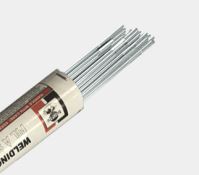
The manufacturing process of these rods ensures a clean, contaminant-free surface, which is critical for preventing weld defects in nickel alloy welding. Each 36-inch rod is straightened and cut to precise tolerances. The 0.093" (3/32") diameter offers versatility for various material thicknesses, allowing for precise heat input control. Packaged in a durable 10lb tube, the rods are protected from moisture and environmental contamination during storage and transport, ensuring they arrive ready for critical code work.
Technical Specifications:
| Additional Information |
|---|
| Brand:Josef |
| Weld Process:TIG (GTAW) |
| Diameter:2.5mm (3/32") |
| Packaging:10 lb Tube |
| Grade:Nickel Copper |
| AWS Classification:ERNiCu-7 |
| Material Composition:Nickel-Copper (Monel) |
| Length:36 in |
| Shielding Gas Requirement:100% Argon, Argon/Helium Mix |
| Polarity:DCEN |
| Tensile Strength:70,000 psi (approx) |
| Packaging Description:10 lb tube |
| Position:N/A |