Skip to Main Content
Canadian
Canadian owned and operated

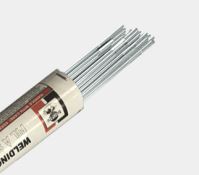
61894000 - Bonarc E7018-1 Low Hydrogen Welding Rods 4.0mm

Packaging: 4.5kg tube
$12.86/kg $36.18/4.5kg tube only $8.04/kgSave 37%

In stock

OVERVIEW

Premium Low Hydrogen Electrodes for Critical Structures

The Bonarc 7018-1 Stick Electrode (4.0mm) is a high-performance SMAW consumable designed for welding carbon and low-alloy steels where weld integrity and mechanical toughness are paramount. Conforming to AWS A5.1 E7018-1 standards, this electrode is engineered to deliver superior impact properties at low temperatures (typically down to -45°C), distinguishing it from standard E7018 classifications. This makes it the preferred choice for industries operating in colder climates or requiring stringent fracture toughness compliance, such as offshore fabrication, bridge construction, and pressure vessel manufacturing.

The electrode features a moisture-resistant, basic low-hydrogen coating enriched with iron powder. This formulation serves two critical functions: it minimizes the risk of hydrogen-induced cracking (cold cracking) in the heat-affected zone, and it enhances the deposition rate, allowing for faster travel speeds and increased productivity. The 4.0mm (5/32") diameter is optimized for filling joints in medium-to-heavy plate thicknesses, offering a balance between deposition volume and puddle control.

Metallurgically, the Bonarc 7018-1 produces a weld deposit with excellent radiographic quality. It is highly resistant to porosity and cracking, even when welding on steels with higher carbon or sulfur content that are traditionally difficult to weld. The slag system is designed to be self-releasing in many joint configurations, reducing post-weld cleaning time and labor costs. Storage and handling should follow standard low-hydrogen practices; re-baking is recommended if the electrodes have been exposed to atmospheric moisture to maintain their low-hydrogen status.

Technical Specifications

  • Classification: AWS A5.1 E7018-1
  • Diameter: 4.0mm (approx. 5/32")
  • Current: DCEP (Direct Current Electrode Positive) or AC
  • Tensile Strength: 70,000 psi minimum
  • Yield Strength: 58,000 psi minimum
  • Charpy V-Notch: 20 ft·lbf at -50°F (-45°C)
Additional Information
Polarity:AC/DC-, DC+
Rod Type:Stick Electrode (SMAW)
Coating Type:Low Hydrogen Iron Powder
Welding Position:All Position (Except Vertical Down)
Tensile Strength:70,000 psi (min)
Impact Toughness:27J at -45°C
Current Type:AC, DCEP
----- new values below ----
Rod Type:Stick Electrode (SMAW)
Coating Type:Low Hydrogen Iron Powder
Welding Position:All Position (Except Vertical Down)
Tensile Strength:70,000 psi (min)
Impact Toughness:27J at -45°C
Current Type:DCEP, AC
Brand:BONARC
Diameter:4.0mm
AWS Spec:E7018-1
Position:ALL
Polarity:DC+
Amp Range:135-220amp

INCLUDED

  • Bonarc 7018-1 Stick Electrodes (4.0mm x 14")

APPLICATIONS

  • Structural steel fabrication (beams, columns)
  • Heavy equipment repair (excavators, bulldozers)
  • Pressure vessel and boiler construction
  • Bridge and infrastructure welding
  • Offshore platform fabrication
  • Shipbuilding and marine repair
  • General maintenance and repair operations (MRO)

FAQ

The primary difference is impact toughness. E7018-1 electrodes are tested to provide specific impact properties at lower temperatures (typically 27 Joules at -45°C), whereas standard E7018 is tested at -29°C. This makes the -1 version suitable for critical applications in colder environments.

For a 4.0mm (5/32") E7018 electrode, the recommended amperage range is typically between 135 and 220 amps. For flat welding, you can run on the higher end (160-190A), while for vertical-up welding, you would typically reduce the heat to around 140-160A to control the puddle.

Yes. As low-hydrogen electrodes, they should be stored in a holding oven at temperatures between 250°F and 300°F (120°C - 150°C) after opening the hermetically sealed packaging to prevent moisture absorption, which can cause hydrogen cracking.

Yes, Bonarc 7018-1 electrodes are designed to operate on both DCEP (Direct Current Electrode Positive) and AC (Alternating Current). However, DCEP usually provides the smoothest arc characteristics and best penetration.

The suffix '-1' indicates that the electrode meets improved impact toughness requirements. Specifically, it signifies that the weld metal has better Charpy V-Notch impact values at lower temperatures compared to a standard E7018.

While E7018-1 rods can handle some mill scale, they are not designed for dirty or rusty metal like an E6010 or E6011. For the best results and to prevent porosity, you should clean the base metal to bright steel before welding.

This is an all-position electrode. It can be used in Flat, Horizontal, Vertical-Up, and Overhead positions. It is not recommended for Vertical-Down welding.